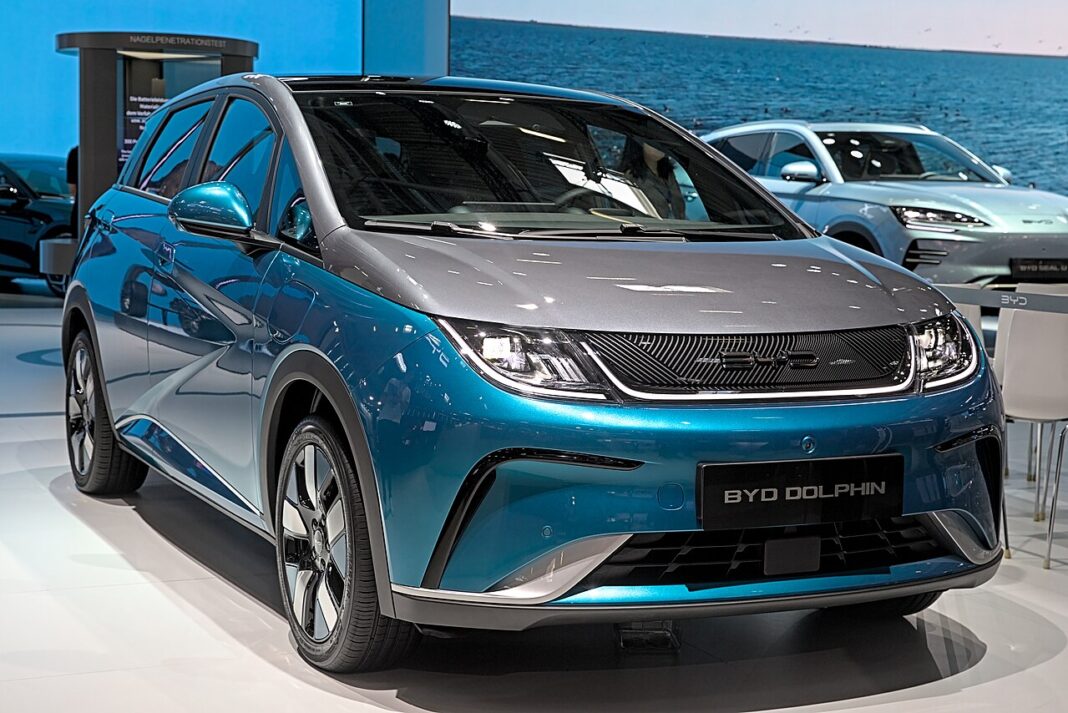
BYD Sales Rise 11% as Electric Vehicle Exports Surge 103% in October 2026
Automotive News | November 3, 2026
BYD sold 490,168 new energy vehicles in October, extending its year-over-year growth streak to six consecutive months. The 11% increase was supported by a sharp rise in overseas shipments and stronger demand for fully electric passenger vehicles, but the company’s latest results also expose a growing divide between its international expansion and performance in China. While exports more than doubled from a year earlier, domestic sales remained below their October 2025 level, and plug-in hybrid deliveries continued to decline.
The figures arrive at an important moment for the world’s largest new energy vehicle manufacturer. BYD is expanding production and distribution outside China, updating some of its most important models and competing in a domestic market where manufacturers are fighting for customers through pricing, technology and frequent product launches. Its October performance therefore represents more than another monthly sales milestone. It provides a closer look at how the company is changing its business as growth becomes harder to achieve in its home market.
The company’s October production and sales disclosure, published on November 2, reported 490,168 new energy vehicle sales, compared with 441,706 a year earlier. The figures are preliminary and have not been audited or confirmed by BYD’s auditors, meaning they could be adjusted when the company releases its financial results. BYD’s October sales disclosure.
BYD Sales Reach a 2026 High, but Year-to-Date Performance Remains Weaker
October was BYD’s strongest sales month of 2026 so far. Deliveries increased 10.97% from the same month last year and rose 5.74% from September’s 463,561 vehicles. The latest result also extended the company’s annual growth streak to six months, following a period when year-over-year comparisons had been more challenging.
However, the improvement in monthly sales should be considered alongside the company’s cumulative performance. BYD sold 3,621,744 new energy vehicles between January and October, down 2.16% from 3,701,852 during the corresponding period of 2025. The decline narrowed from the 3.94% decrease recorded through September, suggesting that recent growth is helping the company recover some of the ground lost earlier in the year.
The difference between monthly and cumulative figures is important. A strong October does not automatically mean that BYD has returned to sustained annual growth. It shows that demand improved, but the company still has to overcome the earlier shortfall. The composition of its sales also matters: fully electric passenger vehicles are expanding, while plug-in hybrids are moving in the opposite direction.
Passenger vehicles accounted for 483,125 of October’s sales, with commercial new energy vehicles contributing another 7,043. The passenger vehicle total was approximately 10.6% higher than a year earlier, while commercial vehicle sales increased by approximately 45.2%. The stronger commercial vehicle result provides another source of growth, although passenger cars remain the dominant part of BYD’s business. BYD’s reported sales breakdown.
Battery-Electric Vehicles Become the Main Growth Driver
The clearest change in BYD’s October results was the performance of its battery-electric passenger vehicle business. The company sold 305,743 fully electric passenger vehicles, up 37.38% from 222,559 in October 2025. Sales also increased from September’s 273,143 units, marking a monthly improvement of approximately 11.94%.
Battery-electric vehicles represented approximately 63.3% of BYD’s passenger vehicle sales in October. Their share was about 59.8% in September and 51% in October last year. This shift shows that fully electric models are becoming a larger part of the company’s passenger vehicle mix rather than relying on plug-in hybrids to contribute an equal share of sales.
The year-to-date figures reinforce the trend. BYD sold 1,935,700 battery-electric passenger vehicles during the first ten months of 2026, an increase of 5.86% from the same period last year. That growth is considerably more moderate than October’s individual monthly increase, but it confirms that the BEV category has remained a positive contributor throughout the year.
The change also reflects the strategic importance of product development. BYD competes across several price segments, from smaller urban electric cars to larger passenger vehicles. Its ability to offer different battery sizes, vehicle formats and technology packages gives it access to customers with different budgets and driving needs. However, rising BEV sales do not automatically establish that customers are abandoning plug-in hybrids. Pricing, model availability, incentives and the suitability of charging infrastructure can all influence which technology buyers choose.
Plug-In Hybrid Sales Decline as the Product Mix Changes
BYD’s plug-in hybrid passenger vehicle sales moved in the opposite direction. The company sold 177,382 PHEVs in October, down 17.23% from 214,297 a year earlier and 3.37% below September’s 183,570 units. The decline contrasts with the strong performance of fully electric models and highlights an increasingly uneven sales picture across the company’s two main passenger vehicle technologies.
Between January and October, BYD sold 1,625,969 plug-in hybrid passenger vehicles, a decrease of 11.02% from 1,827,256 in the same period of 2025. The segment remains substantial, but its weaker performance means that battery-electric vehicles are now providing a greater share of the company’s passenger vehicle sales growth.
The development creates a strategic challenge. Plug-in hybrids can appeal to drivers who want electric driving for shorter journeys while retaining a combustion engine for longer trips. That flexibility can be valuable in markets where charging access is limited. Fully electric vehicles, meanwhile, offer a different ownership proposition, particularly for customers with reliable access to home or workplace charging.
BYD has not abandoned the hybrid market. Its product strategy continues to include both technologies, and the company recently introduced a redesigned Qin Plus DM-i plug-in hybrid. The model’s renewal suggests that BYD is trying to strengthen the competitiveness of its hybrid range rather than allowing the category’s decline to continue without a response.
Overseas Exports More Than Double, but Expansion Requires Local Investment
International shipments were one of the most important contributors to BYD’s October performance. The company exported 170,194 new energy vehicles, compared with 83,904 in October 2025. The increase of approximately 102.8% means overseas shipments more than doubled year over year. Exports represented around 34.7% of BYD’s total October sales, making international demand a major part of its monthly business.
The year-to-date figures show that this is not simply a one-month development. BYD exported 1,513,154 new energy vehicles between January and October, up approximately 93.75% from the corresponding period last year. Nevertheless, exports were lower than September’s 180,700 units, a month-over-month decrease of approximately 5.8%. The annual increase is therefore impressive, but the latest figures do not show uninterrupted month-to-month growth.
One of the clearest examples of BYD’s international strategy is Brazil. Reuters reported in October that the company was seeking permits to double the planned annual capacity of its Brazilian plant to 600,000 vehicles. BYD’s local management said demand was averaging around 30,000 vehicles per month, while the factory was targeting monthly production of 25,000 by the end of 2026. The company also aims to source more than half of its components locally as it moves into 2027, a step intended to meet local requirements and support regional exports.
The Brazilian investment illustrates why overseas expansion involves more than increasing shipments from China. Local manufacturing can help automakers reduce dependence on imported finished vehicles, respond more quickly to regional demand and satisfy local-content rules. It also requires significant capital spending, production planning, supplier development and the ability to maintain competitive costs. BYD’s plans in Brazil show that the company is investing in a longer-term manufacturing presence, not just pursuing short-term export volumes. Reuters’ report on BYD’s Brazilian expansion.
China’s Electric Vehicle Market Is Growing, but Competition Is Intensifying
BYD’s international growth contrasts with its domestic performance. Based on the company’s total sales and reported exports, October domestic sales can be calculated at approximately 319,974 vehicles, around 10.6% below the same month last year. The figure is derived by subtracting reported exports from total sales; it should not be confused with a separately audited domestic retail-sales measure.
The broader Chinese new energy vehicle market, however, is not shrinking. The China Passenger Car Association estimated that wholesale sales of passenger new energy vehicles reached approximately 1.8 million units in October, potentially a monthly record. BYD’s passenger new energy vehicle wholesale total of 483,125 represented roughly 26.8% of that estimated market volume. Geely followed with 213,165 units, while Chery, Changan and Leapmotor also ranked among the leading manufacturers.
This comparison provides important context. BYD remains the largest player in the reported October ranking, but it is operating in a market where other manufacturers are expanding rapidly. Geely, Chery and Leapmotor are competing through new models, pricing and technology, while established international brands and newer Chinese electric vehicle companies are also seeking customers. The challenge for BYD is not simply to sell more vehicles than it did last year, but to defend its position as the market itself continues to expand and competitors improve their products.
The CPCA’s 1.8 million figure is a preliminary wholesale estimate, not a final count of vehicles purchased by individual consumers. It should therefore be used as an indication of market scale rather than a precise measure of retail demand. Even with that qualification, the comparison suggests that BYD’s domestic weakness is company-specific rather than evidence of a broad collapse in China’s electric vehicle market. CnEVPost’s report on CPCA’s October estimate and manufacturer rankings.
New Models Show How BYD Is Responding to Pressure
BYD’s product launches in October offer another indication of how it is responding to competition. On October 20, the company introduced the second-generation Seagull in China. The redesigned electric hatchback starts at 65,900 yuan and is larger than its predecessor, with seating for five instead of four. Selected versions also support BYD’s flash-charging technology, which the company says can charge the battery from 10% to 70% in five minutes at compatible charging stations.
The company followed that launch with the third-generation Qin Plus DM-i on October 27. The updated plug-in hybrid sedan received a larger body and improvements to its electric driving capability, with LiDAR available on certain versions. The timing is notable because the Qin series has faced sales pressure, making the redesign part of BYD’s effort to refresh an important model family while plug-in hybrid deliveries are declining.
These launches do not prove that the models will reverse the company’s sales trends. Their commercial impact will depend on pricing, customer response, production availability and the strength of competing vehicles. They do, however, show that BYD is using product renewal to address pressure in both its electric and hybrid lineups. CnEVPost’s report on the second-generation Seagull and its report on the third-generation Qin Plus.
BYD’s Financial Results Show Why Sales Growth Is Not the Whole Story
The difference between vehicle sales and financial performance is particularly important for BYD. The company’s third-quarter results, reported on October 29, showed net profit rising 28% year over year to 10 billion yuan. Revenue increased 13.6% to 221.5 billion yuan, ending four consecutive quarters of revenue contraction. Although both figures represented growth, profit was below the estimates compiled by Reuters, which ranged from 11.4 billion to 12.95 billion yuan.
The figures show why rising deliveries should not automatically be interpreted as improving profitability. BYD is selling more vehicles in overseas markets, but international expansion brings additional costs related to factories, distribution, logistics, marketing and after-sales support. Competition can also require manufacturers to offer more attractive prices, potentially limiting the profit earned on each vehicle.
Reuters also reported that BYD’s accounts receivable had increased 52.6% since the end of 2025 and inventories had risen 60.1%. Those figures do not, by themselves, establish a financial problem. They do, however, make working capital and inventory management important areas to monitor as the company expands production and sales across multiple markets.
The central financial question is whether BYD can convert its growing international presence into sustainable revenue and profit without relying excessively on price reductions or allowing operating costs to rise faster than sales. Its third-quarter results show that revenue growth has returned, but the earnings miss demonstrates that stronger sales momentum does not remove the pressure on profitability. Reuters’ coverage of BYD’s third-quarter financial results.
What BYD’s October Results Mean for the Months Ahead
BYD enters the final months of 2026 with several competing trends. Overseas shipments are expanding rapidly, battery-electric passenger vehicles are gaining share, and new models are being introduced to strengthen the company’s product lineup. At the same time, cumulative sales remain below last year’s level, plug-in hybrid deliveries are declining and domestic competition continues to put pressure on the business.
The company’s international manufacturing plans could become increasingly important if trade barriers and local-content requirements make direct exports more difficult in certain markets. Brazil offers an example of how local production can support a more established regional presence, but building and operating factories at scale also requires substantial investment and careful management.
The next sales reports will help establish whether October’s improvement represents a lasting recovery or another strong month within a more complicated year. Investors will also need to watch revenue, margins, inventories and cash generation rather than relying on vehicle deliveries alone. For the global electric vehicle industry, BYD’s performance illustrates both the opportunities available to Chinese manufacturers abroad and the growing difficulty of maintaining rapid growth in an increasingly competitive market.